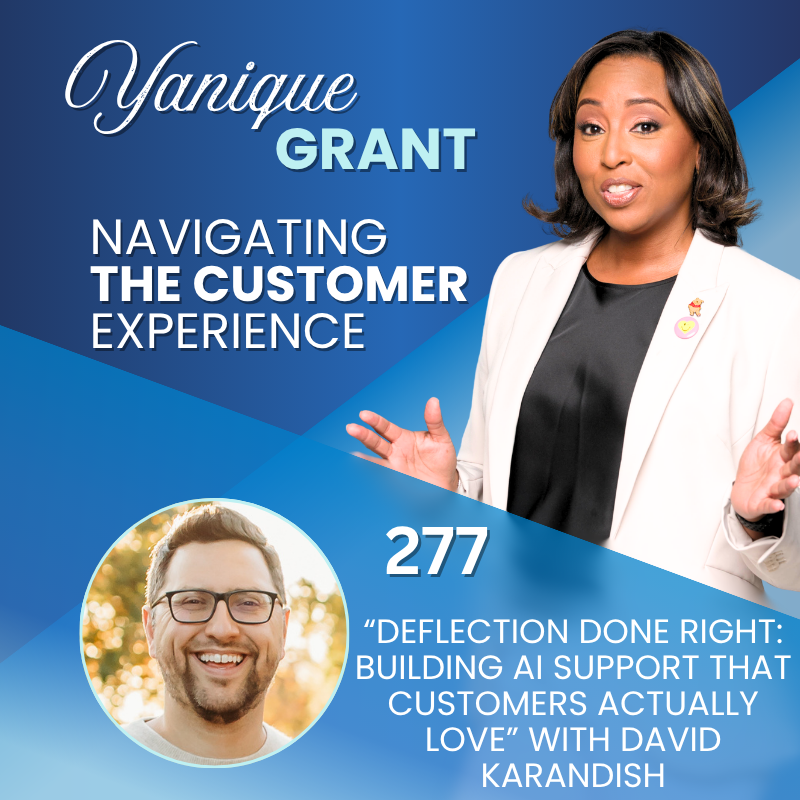
Guest Bio
David Karandish is the founder and CEO of Capacity, an enterprise SaaS company headquartered in St. Louis, Missouri. Capacity is a support automation platform that uses AI to deflect emails, calls, and tickets so internal and external support teams can spend more time doing their best work. Today Capacity serves roughly 20,000 customers and connects to over 250 of the apps businesses already use.
David has spent the last 17 years in the question-and-answer space. Before Capacity, he was CEO of Answers Corp; he and his business partner Chris Sims started the parent company of Answers.com in 2006 and sold it to a private equity firm in 2014 for $960 million. He sits on the board of Create-A-Loop, a computer science education non-profit tackling the digital divide, and was an early investor and board member at Nerdy (NYSE), an on-demand learning platform in the ed-tech space.
David lives in St. Louis with his wife Erin and their four children. When he’s not working, he enjoys spending time with his family and playing the ukulele.
Questions Yanique Asked
- Could you share a little about your journey — how you got from where you started to where you are today?
- How do you design AI support so that deflection actually improves the customer experience rather than frustrating people who just want a human?
- Do the follow-up questions customers ask differ based on culture or region, or are they largely universal?
- What did the Answers journey teach you about what customers really want when they’re searching for help, and how did that shape Capacity?
- For leaders running support teams of any size, what’s the most practical first step to bring AI into their operations without overwhelming their team or budget — and what should they avoid?
- What’s the one online resource, tool, or application you absolutely can’t live without in your business?
- Are there one or two books that have had a positive impact on you personally or professionally?
- What’s one thing going on in your life right now that you’re really excited about?
- Where’s the best place for listeners to connect with you online?
- Do you have a quote or saying you revert to during times of adversity or challenge?
Episode Highlights
From Website Wizard to the Question-and-Answer Business
Yanique: Could you share a little about your journey — how you got from where you started to where you are today?
David graduated high school in 2001, back when being able to build a website made you “somewhere between a wizard and a warlock.” After university he started Announce Media, a portfolio of vertical search sites in the question-and-answer space, which led to acquiring Answers.com and eventually the $960 million exit.
When it came time to start Capacity, the team asked a simple question: what if you could use AI to automate support anywhere you get lots of tickets, emails, and phone calls? They began on the internal side with HR, IT, onboarding, and training questions, then quickly pivoted to customer-facing support. Capacity has since grown from a single web chatbot into a true omni-channel platform spanning voice, SMS, WhatsApp, web, and email.
Designing Deflection That Elevates, Not Frustrates
Yanique: How do you design AI support so that deflection actually improves the customer experience rather than frustrating people who just want a human?
The core principle: this technology should improve the customer experience, not degrade it. David breaks that down into a handful of non-negotiables.
- A great escalation path: no one should ever get stuck with a virtual agent that can’t reach a human — always give customers a quick “phone a friend” button.
- No starting from scratch: when a customer escalates, the human shouldn’t re-ask the same 10 questions the virtual agent just asked.
- Full context up front: tie the agent into your CRM, ordering system, and systems of record so it isn’t coming in blind — it already knows about last week’s order that didn’t ship.
- Anticipate the next question: train the AI on a big enough data set that it knows the common questions and the questions behind the questions.
- Lead with empathy: don’t be curt, but don’t be too bubbly either — “have a wonderful day” is the wrong thing to say to an irate customer.
- Never ask twice: it’s fine to collect information once, but don’t make customers enter it again.
Get those four or five principles right, David says, and while it won’t guarantee success, you’ll be better than nine out of ten automated experiences out there today.
Humans Are Humans — With Regional Nuance
Yanique: Do the follow-up questions customers ask differ based on culture or region, or are they largely universal?
David’s take: people are people. The underlying human behavior tends to be consistent across regions, but differences show up where the products themselves differ. His example — a computer manufacturer has different keyboards in different regions, so a customer in Spain or Mexico might ask about the Ñ key that a U.S. English customer never would.
Where products carry little customization, the questions stay largely the same; the frequency might shift, but the fundamentals hold.
What the Answers Journey Taught Him About Getting Stuck
Yanique: What did the Answers journey teach you about what customers really want when they’re searching for help, and how did that shape Capacity?
Answers.com started as a wiki where anyone could ask anything — from “my girlfriend broke up with me, what should I do?” to “what’s the best animal at the San Diego Zoo?” Most of it was user-generated curiosity with little commercial value.
But a tiny subset of questions came from people who were genuinely stuck — in a support situation or a buying decision — with nowhere else to turn. That frustration was the genesis of Capacity: what if you could help organizations build a better support system for exactly those moments?
Go Get Your Small W: The Practical First Step
Yanique: For leaders running support teams of any size, what’s the most practical first step to bring AI into their operations without overwhelming their team or budget — and what should they avoid?
The very first move is to go get your “small w win.” Before overhauling the entire contact center or trying to eat the whole elephant in one bite, land a win that proves to your internal team that the technology makes a real difference.
- It has to be a real win: don’t chase a project with no benefit just because the tech is shiny and new.
- Keep it small: don’t make the win so large that it becomes a multi-month or multi-year change-management project.
- Prove, then iterate: teams that land the first win tend to get hungrier and hungrier for more AI solutions.
Agents Running the Whole Company
Yanique: What’s one thing going on in your life right now that you’re really excited about?
David is most excited about Capacity’s “builder agents.” What used to require dragging, dropping, and connecting workflow pieces by hand now happens by simply telling an agent what you want — “build a workflow for onboarding” or “create a CSAT survey” — and it does it.
He frames Capacity’s work in three layers: the AI agents deployed for customers, the builder agents that help customers launch more agents faster, and the internal agents that run the entire company. As he puts it, there isn’t an activity from finance to marketing that doesn’t start with an agent.
Key Takeaways
- AI support should improve the customer experience, not degrade it — that’s the standard every deployment should be measured against.
- Always give customers a fast, reliable escalation path to a human, and make sure that human inherits the full context so nothing gets re-asked.
- Feed the virtual agent context from your CRM and systems of record so it never comes in blind on a customer’s history.
- Train AI to anticipate the “question behind the question” and to respond with genuine empathy, matching tone to the customer’s emotional state.
- Never make a customer provide the same information twice; collect it once and carry it forward.
- Human behavior is largely universal across regions; differences in support questions usually track differences in the products themselves.
- Start your AI journey with a small, genuine win that proves value — then iterate outward rather than boiling the ocean.
- First-principles thinking matters: define what has to be true to get the result you want, and diagnose failures against those inputs.
- AI agents can now run internal operations end to end from finance to marketing not just customer-facing chat.
- Every organization is perfectly designed to get the results it’s getting; if the results are wrong, look at the design.
Timestamped Topics
- 00:00 – Introduction and Guest Bio
- 02:09 – David’s Journey: From Web Pages to Answers.com to Capacity
- 03:48 – Designing AI Deflection That Improves the Customer Experience
- 06:03 – Do Customer Questions Differ by Culture and Region?
- 07:22 – What the Answers.com Journey Taught Him About Getting Stuck
- 08:48 – The Practical First Step: Go Get Your Small Win
- 09:56 – The Tool He Can’t Live Without: Foundational AI Models
- 10:54 – Book Recommendation: Principles by Ray Dalio
- 11:41 – What He’s Excited About: Builder Agents
- 13:13 – Where to Connect with David
- 13:26 – Guiding Quote and Wrap-Up
Featured Resources
Books Mentioned
- Principles by Ray Dalio — a first-principles breakdown of how Dalio built one of the most successful investment firms of all time.
Tools and Platforms
- Foundational AI models — Google Gemini, OpenAI, and Anthropic’s Claude, used across the business.
- Jira — for tracking development tickets; David uses LLMs to analyze time-in-stage when off-the-shelf plugins fall short.
David’s Venture
- Capacity — an AI-powered support automation platform that deflects emails, calls, and tickets across voice, SMS, WhatsApp, web, and email. ~20,000 customers, 250+ app integrations.
Connect with David Karandish
- Website: capacity.com
- Email: david@capacity.com
David’s Guiding Quote
“Every organization is perfectly designed to get the results it’s getting.” David returns to this whenever a team isn’t hitting its goals, if the results aren’t what you want, look at the organization’s design and you can usually spot the problem.
About Navigating the Customer Experience
A globally recognized podcast hosted by Yanique Grant, featuring leaders and innovators sharing insights on leadership, business growth, customer experience, and exceptional service delivery.
Follow Us
- X (Twitter): @NavigatingCX
- Facebook: Navigating the Customer Experience Community
- LinkedIn: Yanique Grant
- Website: yaniquegrant.com