
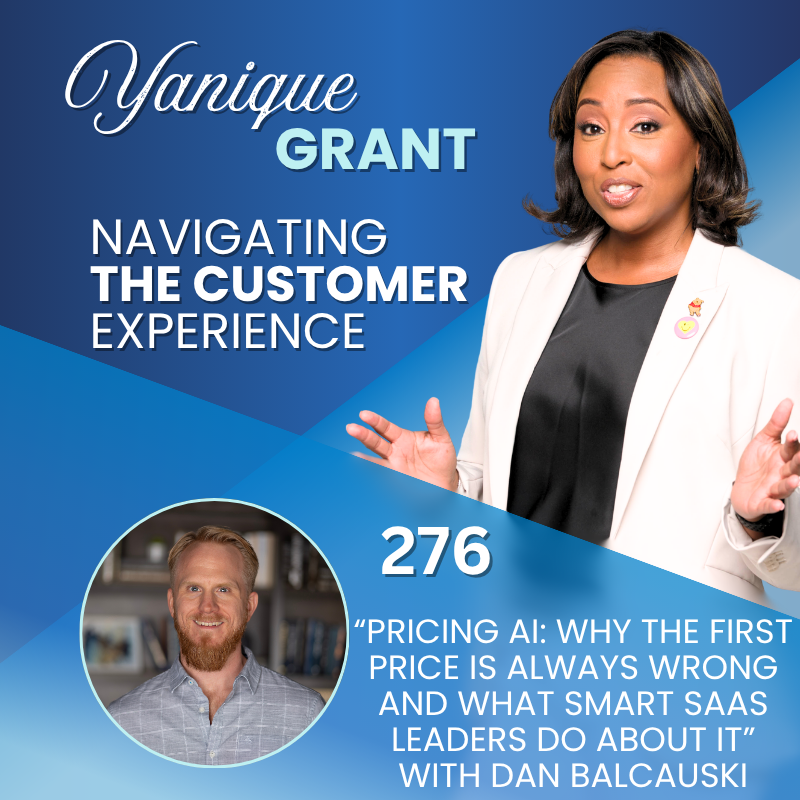
Guest Bio
Dan Balcauski is the founder of Product Tranquility, where he helps B2B SaaS CEOs turn pricing from a confusing liability into a strategic advantage. With more than 20 years in software, Dan began his career as an engineer before moving into product management and discovering that how companies capture value matters far more than how they build it.
His work now centers on one of the most pressing questions in software today: how to price AI. Dan advises SaaS companies on AI pricing and packaging decisions, including how to set usage caps with no historical data, when to bundle AI versus sell it separately, and why the first AI price a company sets is always wrong.
Before founding Product Tranquility, Dan was a principal product strategist at SolarWinds and head of product at LawnStarter. He holds a BSc in computer engineering from Iowa State University and an MBA from the Kellogg School of Management at Northwestern, where he also helps teach executive education courses on product strategy. He is the host of the SaaS Scaling Secrets podcast.
Questions Yanique Asked
- In your own words, could you share a little about your journey and how you got from where you were to where you are today?
- You have said the first AI price is always wrong. Why is that, and what should a SaaS company do differently knowing they are going to get it wrong the first time?
- So many companies are trying to set usage caps and pricing tiers for AI with zero historical data to guide them. How would you advise a CEO to make that decision when they are essentially flying blind?
- What is the one online resource, tool, website, or application that you absolutely cannot live without in your business?
- Can you share one or two books that have had a positive impact on you, professionally or personally?
- What is one thing going on in your life right now that you are really excited about?
- Do you have a quote or saying that keeps you on track during times of adversity?
- Where can listeners find and connect with you online?
Episode Highlights
From Engineer to Pricing Strategist: The Journey That Built the Work
Yanique: Tell us about your journey from where you were to where you are today.
Dan spent his early career as a software engineer and quickly learned it did not suit his personality. What drew him in instead was a bigger question: how do companies decide what to build in the first place? That curiosity pulled him toward product management, roadmap ownership, and eventually an MBA at Kellogg, where he took his first formal courses in pricing.
A pivotal internship at a Silicon Valley startup put a real pricing decision on his desk, and he began to see how differently pricing works across industries. Selling airline seats is not the same as selling shampoo, and neither is the same as selling B2B software. After leading product at several companies and repeatedly being asked to help colleagues untangle pricing they were never trained for, Dan founded Product Tranquility to help SaaS companies turn pricing from a source of confusion into a strategic asset.
| “Pricing everywhere is not the same. I got those scars so you don’t have to.” — Dan Balcauski |
Why the First AI Price Is Always Wrong
Yanique: You have said the first AI price is always wrong. Why is that, and what should companies do about it?
Dan is clear that this has nothing to do with how smart your team or your consultants are. The software business is going through a fundamental economic shift, and both sides of the pricing equation are moving at once. On the cost side, he points to a benchmark showing the cost per task for a top model dropping by roughly 390 times in a single year. No normal business absorbs that kind of change in its cost of goods sold. On the value side, models keep getting more capable, handling tasks this month that they could not handle last month.
His research bears this out: every application-layer software company he has studied that released AI capabilities revised its pricing and packaging within 18 months. The takeaway is not to price perfectly on day one, but to build for change. Dan urges leaders to adopt a mindset of agility, review pricing far more often than the old annual or five-year cadence, and treat communication as paramount. Where pricing changes tend to blow up is not the change itself but the fact that it was communicated poorly or not at all.
| “Whether we want to stay in place or not, it is not a choice we get to make. The technology is changing and our competitors are changing.” — Dan Balcauski |
Setting Usage Caps With No Data: The Early Access Playbook
Yanique: How would you advise a CEO to set usage caps and tiers for AI when they have zero historical data to guide them?
Dan frames the real problem plainly: you know what a token costs, but you have no idea what customers will actually do with a new AI feature. Products are full of features that barely got adopted, and AI features do not get to skip that step of the innovation cycle. At the same time, a small group of power users, often around 5 to 10 percent, can drive the overwhelming majority of usage and cost. That makes tempting shortcuts unreliable. Using dashboard views as a proxy breaks down because good AI gets used far more than the dashboards it replaces, and a beta group rarely matches the usage profile of the full market.
His recommended move is an early access stage that sits between beta and general availability. Companies announce their limits, put a price on the feature, and communicate it clearly, but they do not enforce or meter it yet for a defined window that can run anywhere from six weeks to 18 months. This eases customer anxiety about surprise bills, encourages real adoption, and lets the company gather genuine usage patterns instead of guessing from proxies.
Dan adds an important nuance: separate ordinary plan limits from fair use limits. Even when you are not metering usage, you can reserve the right to throttle or downgrade the rare customer using a capability a hundred or a thousand times more than the average, much like companies already do with API request limits. Those levers let teams keep experimenting during early access without the CFO having a heart attack when the bill arrives.
| “Early access eases user anxiety, encourages adoption, and helps you ground your pricing in real usage patterns instead of proxies that break down.” — Dan Balcauski |
Key Takeaways
- The first AI price is always wrong, and that is not a failure of intelligence. It reflects a fundamental economic shift where both cost and value are moving fast.
- Every application-layer company Dan studied revised its AI pricing and packaging within 18 months. Plan for revision, not perfection.
- Agility beats certainty. Review pricing on a quarterly cadence rather than annually or every five years.
- Communication is where pricing changes succeed or fail. Most blowups come from poor communication, not the change itself.
- Usage proxies break down. Dashboard views and beta groups rarely predict how customers will actually use an AI feature.
- A small group of power users can drive the majority of usage and cost, so average-user assumptions are dangerous.
- Early access is the smart middle stage. Announce and price the limits, communicate them, but do not meter yet while you gather real data.
- Separate plan limits from fair use limits. Reserve the right to throttle extreme usage even when you are not metering everyone.
- Do not borrow problems from the future. Anxiety about what has not happened yet only adds problems to the present.
- AI is making custom, personal business software economically viable for the first time, opening the door to tools built exactly the way you work.
Timestamped Topics
| Timestamp | Topic |
| 00:00 | Introduction and Guest Bio |
| 01:51 | Dan’s Journey: From Engineer to Pricing Strategist |
| 04:03 | Learning That Pricing Is Different in Every Industry |
| 04:49 | Why the First AI Price Is Always Wrong |
| 05:36 | The 390x Cost Shift and the Moving Value Equation |
| 06:49 | Agility, Faster Pricing Reviews, and Communication |
| 09:28 | Setting Usage Caps With No Historical Data |
| 11:32 | Why Dashboard Proxies and Beta Groups Break Down |
| 12:59 | The Early Access Playbook Between Beta and GA |
| 13:20 | Plan Limits vs. Fair Use Limits |
| 17:04 | The One Tool Dan Cannot Live Without: Claude Code |
| 17:38 | Book Recommendation: Monetizing Innovation |
| 18:31 | Building Custom Business Software With AI |
| 19:55 | How to Connect With Dan Online |
| 20:27 | Dan’s Guiding Quote: Don’t Borrow Problems From the Future |
Featured Resources
Books Mentioned
Tools and Platforms
- Claude Code (Dan’s go-to work surface and the engine behind his custom business software)
Dan’s Venture
- Product Tranquility. Pricing and packaging strategy for B2B SaaS CEOs.
- SaaS Scaling Secrets. Dan’s podcast, available wherever podcasts are found.
Connect with Dan
- LinkedIn: Search Dan Balcauski on LinkedIn (mention that you heard him on the podcast so he can separate you from the spam)
- Website: producttranquility.com
- Podcast: SaaS Scaling Secrets, wherever podcasts are found
Dan’s Guiding Quote
| “Don’t borrow problems from the future.” — Dan Balcauski |
Dan explains that most of our anxiety is about things that have not happened yet. Worrying about a future scenario pulls that problem into the present before it ever arrives, giving you more to carry now for no reason. Like debt, it is borrowing against your future self. His practice is to stay focused on what is real and in front of him, which keeps him grounded when challenges or uncertainty threaten to pull him off track.
About Navigating the Customer Experience
A globally recognized podcast hosted by Yanique Grant, featuring leaders and innovators sharing insights on leadership, business growth, customer experience, and exceptional service delivery.
Follow Us
- X (Twitter): @NavigatingCX
- Facebook: Navigating the Customer Experience Community
- LinkedIn: Yanique Grant
- Website: yaniquegrant.com