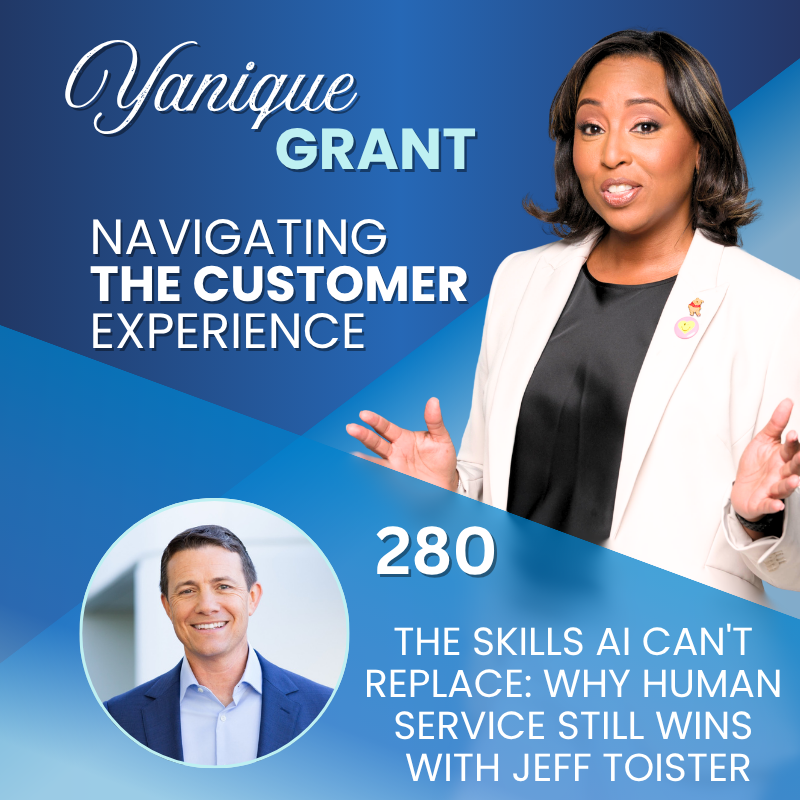
Guest Bio
Jeff Toister’s very first customer service interaction ended in a service failure. Rather than walk away, he became obsessed with figuring out what great service really takes, and he has spent his career answering that question.
Today Jeff is the best-selling author of four books, including the Service Culture Handbook and his newest release, Human Service: The Skills AI Can’t Replace. More than 11,000 customer service professionals worldwide subscribe to his Customer Service Tip of the Week email, and over 5 million people have taken his training courses on LinkedIn Learning.
A returning guest on the show, Jeff focuses on service culture: how you get an entire team absolutely obsessed with service. His latest research digs into where humans still add irreplaceable value in a world racing to automate everything.
Questions Yanique Asked
- You have written many books and it’s been about nine years since your last visit. Catch us up on what you’ve been up to over the last couple of years.
- Your new book focuses on three themes: connection, understanding, and advocacy. Can you start us off with connection and why it matters?
- Can you expound on understanding and advocacy, and why these are the critical themes that help us feel less intimidated by AI?
- I spent hours at the mall and nobody helped me find what I wanted. Do you see AI working in that space, or is a human best suited for that kind of service?
- As we head into the close of 2026, what are one or two things customer service leaders and business owners need to prepare for?
- What’s the one online tool, website, or application you absolutely can’t live without in your business?
- What’s one thing going on in your life right now that you’re really excited about?
- Does a warm, human greeting have the same impact in a face-to-face interaction as it does on the phone?
- Where’s the best place listeners can connect with you online?
- Do you have a quote or saying you revert to during times of adversity or challenge?
Episode Highlights
Connection Is Not Just Nice, It’s Efficient
Yanique: Your book focuses on connection, understanding, and advocacy. Start us off with connection.
Jeff’s core focus has always been service culture: how do you get an entire team absolutely obsessed with service? His newest research tackles the question so many people are wrestling with right now, which is where humans still have a role to play in a world of AI. His answer is clear: we have a big role.
Connection is the first principle, and it is more powerful than most leaders realize. Human brains naturally detect the signs of a genuine connection, and that sense of belonging measurably improves the service experience. Jeff’s research on customer service greetings shows the payoff is not just emotional, it’s operational.
Believe it or not, creating connection is efficient. Connecting at the start of a call and building authentic rapport makes phone calls 16% shorter, because the customer and the representative end up working together throughout the interaction.
Understanding and Advocacy: Where Humans Outperform AI
Yanique: Can you expound on understanding and advocacy, and why they are so critical?
Jeff starts by locating where humans actually belong. A lot of service work is transactional, like updating an account or making a purchase. It is rote, it doesn’t change much, and most of us prefer doing it digitally because it’s fast. AI and automation are great for those moments.
Where human skills shine is the moment something feels complicated or has gone wrong and the customer needs confidence it will be made right.
- Understanding: hearing beyond the words to grasp the customer’s real intent and the emotions behind it. Humans are excellent at reading intent and empathy; automation struggles with both.
- Advocacy: working on the customer’s behalf to secure a better outcome. AI simply doesn’t care whether you have a good experience; it follows its programming. A human can go beyond policy and broken procedure and use creativity to solve what automation cannot.
The Mall Test: The Transactional Human vs. the Expert
Yanique: Nobody at the mall helped me find what I wanted. Is AI or a human best for that?
Yanique shared a real frustration: four hours at the mall, employees quoting discounts but never asking what she actually wanted, the event, her body type, or her taste. Jeff reframed the problem around a hierarchy of service.
Right now, AI can beat a purely transactional employee who just points to a rack or repeats the sale terms, because that person adds no human value. Ask ChatGPT or Claude what you’re looking for and it will increasingly offer smart options.
But an expert who greets you warmly, knows the store and product, understands what you’re truly after, and guides you to the right item, and even suggests options you never considered, delivers an experience AI can’t match. Customers feel more confident and are more likely to buy. As Jeff puts it, automation isn’t replacing the human; it’s replacing the transactional person impersonating a robot. The real call to action is to demand humans become that expert.
Yanique’s ChatGPT-generated outfit that Express didn’t actually carry proved the flip side too: AI is only as good as its data. That’s exactly why understanding matters, because a great human expert can offer alternatives that work even better than the picture in your head.
Preparing for 2027: Simplify and Get Focused
Yanique: What should customer service leaders prepare for as we close out 2026?
Jeff’s advice to leaders drowning in options is to simplify. Too many teams chase the latest technology without asking what problem it actually solves. He offers a three-step reset:
- Define it: decide what a great experience actually looks like.
- Communicate it: share that vision clearly with the entire team.
- Align to it: line up every decision, including technology choices, around creating that experience consistently.
Start with the experience you want, align the team around it, and the right tools become obvious. Get the basics right, greet, welcome, understand, and advocate, and you avoid sending customers on a four-hour search that ends in nothing.
The Greeting Research: 16% Shorter Calls, Warmer Customers
Yanique: What are you most excited about working on right now?
Jeff just finished the third study in a series on customer service greetings, this one analyzing more than 370,000 phone calls. A warm, conversational greeting, something as simple as “Hi, thanks for calling, this is Jeff, how may I help you?”, outperforms the robotic monotone or verification-first greeting in measurable ways.
- 16% shorter calls: a friendly, conversational greeting shortens the interaction compared to a robotic one.
- 12% better first-contact resolution: warmth at the start improves the odds the issue is solved on the first try.
- Higher sentiment: customers simply feel better about the interaction.
In person, the numbers are just as striking. In a study of over 400 face-to-face interactions at a coffee-shop chain, only about half of customers were greeted at all. The scripted corporate greeting at the door often backfired because customers hadn’t yet oriented themselves. But natural, human greetings, a smile and a wave as the customer approached, then a genuine “good morning”, got 69% of customers to smile back, versus just 3% for the corporate standard. About 75% returned the personal greeting. Jeff’s takeaway, delivered with a laugh: the remaining 25% who won’t return a warm greeting are just a little unkind.
The Security Guard Who Sang: Personality as Service
Yanique: Has anyone ever welcomed you in a way that stopped you in your tracks?
Yanique told the story that has stayed with her since last September: a security guard at a Jamaican logistics company moved the cone, directed her parking, then walked over and sang her welcome by name. She was in shock, not because it was strange, but because no one ever does that.
What made it powerful was authenticity. The guard wasn’t even employed by the logistics company; she worked for an outsourced security firm, and singing was nowhere in her job description. She simply brought her personality to the work. Jeff’s point lands the lesson: you don’t have to sing. The goal is to genuinely make people feel welcome, and every one of us can figure out our own way to do that.
Key Takeaways
- AI won’t replace humans in service; it replaces the transactional employee who acts like a robot. The path forward is to become the expert AI can’t match.
- Connection is efficient, not just pleasant. Authentic rapport at the start of a call makes it 16% shorter.
- Understanding means hearing the customer’s real intent and emotions, not just their words. Humans excel at intent and empathy; automation struggles with both.
- Advocacy is going beyond policy and broken procedure to get the customer a better outcome. AI follows its programming; it doesn’t care about the result.
- Let AI handle simple, rote transactions and reserve human skill for complex issues and moments when something has gone wrong.
- A warm, conversational phone greeting improves first-contact resolution by 12% and lifts customer sentiment.
- In person, natural greetings beat scripted ones: 69% of customers smiled back at a genuine welcome versus only 3% for the corporate standard.
- AI is only as good as its data, so it can confidently point you to options that don’t actually exist. A human expert can offer better alternatives you hadn’t considered.
- To prepare for the year ahead, simplify: define the experience you want, communicate it to the team, and align every decision, including technology, around it.
- Personality is a service differentiator. Small, authentic touches, like a genuine welcome, create moments customers remember and repeat for years.
Timestamped Topics
- 00:00 – Introduction and welcome back
- 01:26 – Catching up: from Service Culture to Human Service
- 03:05 – Connection: the first principle (and why it’s efficient)
- 04:09 – Understanding and advocacy: where humans beat AI
- 06:53 – The mall test: transactional employee vs. true expert
- 11:05 – When AI is only as good as its data
- 12:33 – Preparing for 2027: simplify and get focused
- 15:08 – The one tool Jeff can’t live without
- 16:46 – The greeting research: 370,000 calls, 16% shorter
- 19:11 – Warm greetings face-to-face
- 20:38 – The security guard who sang a welcome
- 23:20 – Where to connect with Jeff
- 24:11 – Jeff’s guiding concept: what’s the goal?
- 25:55 – Closing and follow the show
Featured Resources
Books Mentioned
- Human Service: The Skills AI Can’t Replace by Jeff Toister
- The Service Culture Handbook by Jeff Toister
Tools and Platforms
- Zoom (video conferencing Jeff uses daily, while noting no single tool is truly indispensable)
- LinkedIn Learning (home to Jeff’s training courses, taken by 5 million-plus learners)
- Customer Service Tip of the Week (Jeff’s free weekly email with content to share with your team)
Connect with Jeff Toister
- Human Service book (download the first chapter free): humanservicebook.com
- Customer Service Tip of the Week (free weekly research and tips): toistersolutions.com/tips
- Reply directly to any weekly email and it goes straight to Jeff
Jeff’s Guiding Concept
Jeff doesn’t lean on a quote so much as a concept: “Take a deep breath and ask, what is the goal? What is the result?” That single question brings clarity about the right decision. When working with teams, he adds a second step, making sure everyone shares the same understanding of even the most basic words, like what customer service actually means. Boiling things down to the basics, he says, has worked really, really well.
About Navigating the Customer Experience
A globally recognized podcast hosted by Yanique Grant, featuring leaders and innovators sharing insights on leadership, business growth, customer experience, and exceptional service delivery.
Follow Us
- X (Twitter): @NavigatingCX
- Facebook: Navigating the Customer Experience Community
- LinkedIn: Yanique Grant
- Website: yaniquegrant.com