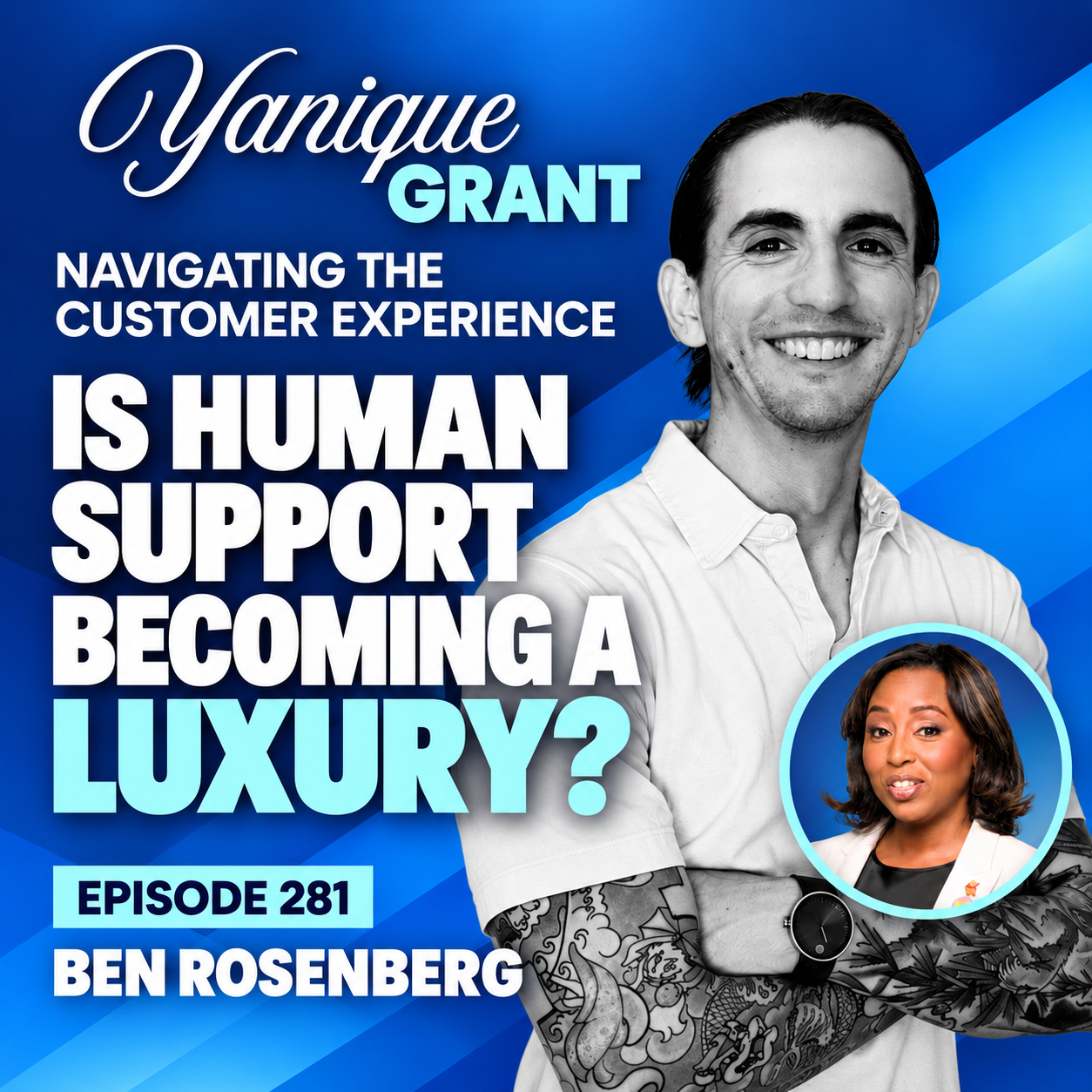
A few years ago, reaching a real person was simply part of good service. Today many customers have to work their way past a chatbot, a phone menu and three help articles before they hear a human voice. So on this week’s episode of Navigating the Customer Experience, I asked Ben Rosenberg, who leads customer support, enablement, education and community at ChurnZero, a question I have been wrestling with for months: is human customer support becoming a luxury?
His answer was honest, and it should make every service leader stop and think about who in their customer base still gets to talk to a person.
The Two Tier Service Model Is Already Here
Ben did not hesitate. Yes, human support can become a luxury, and in many businesses we are already partly there. In B2B especially, the service experience often depends on customer segment, support tier or contract size. Larger accounts get a named person. Everyone else gets a portal. As automation improves, Ben expects that gap to widen.
In my work training frontline teams and leaders, I see the same pattern show up in a quieter way. Nobody sets out to create second class customers. It happens one cost saving decision at a time, until the only people who can reach a human are the ones who pay the most.
Human Service as a Strategic Choice, Not a Perk
What I loved about this conversation is that Ben does not see this as all bad news. He sees an opening. Picture two companies selling a similar product:
- Product A offers a fully automated, bot driven customer experience.
- Product B deliberately keeps a human based experience as its competitive advantage.
In a market where everyone automates, the company that chooses people stands out. I agree completely. When a customer has a real problem, they want to know that a living, breathing person has heard them and that something is actually being done about it. That reassurance is not a luxury. It is the moment loyalty is won or lost.
Where AI Still Falls Short
Ben remembers building password reset flows 10 to 15 years ago, trying to predict every way a customer might type “password,” “reset” or “can’t log in.” Generative AI has made that kind of simple, predictable request far easier to handle.
The harder problem is context. In B2B software, the right answer often depends on how a customer’s account is configured and what they are ultimately trying to achieve, and there are many paths to get there. Putting those pieces together still takes human understanding, and Ben believes we are a ways off from delivering that at scale.
Why Traditional Customer Education Is Breaking
Ben also owns customer education at ChurnZero, and his team ran a revealing experiment. They spent roughly three months analyzing whether customers who completed courses were more likely to adopt key features or reach business outcomes. However they sliced the data, they could not find a definitive link.
He then asked five or six hundred people a simple question: the last time you had to learn something, what did you do? Not one person said they wanted to sit through a full course. They went to YouTube, Google or a chat assistant.
This matches what I hear from the people I train. Between commutes, family, school pickups and continuing education, nobody has 30 spare minutes for a course. Short video works because it feels like someone standing beside you, showing you exactly what to do.
Train for the 90 Percent
Some users will become power users, but about 90 percent just do not care about your tool. They want to figure it out and get on with their day.
So ChurnZero now starts from the action it wants a user to take and works backwards, delivering the right content to the right person at the right moment. Three principles stood out:
- Tie content to action. Every piece of learning should lead to something the user actually does.
- Go in product. Meet people where they already work instead of sending them to a separate portal.
- Build reusable assets. One piece of content can live in a knowledge base, an in product walkthrough and a YouTube video.
Four Questions to Ask Your Team This Quarter
Here is how I would turn this conversation into action if you lead a service team:
- Which customer moments are “real problem” moments, where a human must always be reachable?
- Can every customer reach a person when something has gone wrong, or only your premium accounts?
- Is your training built around hours completed, or around the specific actions you need people to take?
- Are your frontline people trained in the human skills that make choosing a person worth it? If not, join our live CX Edge session, Heart Over Hardware: Mastering the Human Skills AI Can’t Touch, on Tuesday, October 13.
Key Takeaways
- A two tier service model already exists in many businesses, and automation is likely to widen the gap.
- Human service can be a deliberate competitive advantage, not just a premium perk.
- AI handles simple, predictable requests well, but complex questions still need human understanding of context.
- Course based customer education is losing ground to short, searchable, in the moment help.
- Design training around the actions you need people to take, because most users will never be power users.
Listen to the Full Conversation
This article is drawn from the full podcast episode and show notes. You can also listen to Navigating the Customer Experience on Apple Podcasts, Spotify and YouTube.
Want Help Applying This to Your Team?
I help service teams in South Florida, Jamaica and across the Caribbean turn insights like these into everyday behaviour through customer service training, mystery shopping and CSAT research. Book a free 30 minute CX strategy conversation and we will map out the right next step for your team.
About the Author
Yanique Grant is a customer experience expert, trainer and researcher with more than 17 years of experience and over 50,000 professionals trained across Jamaica, the Caribbean and Africa. She is a Service Quality Institute certified Customer Service Trainer, certified in Training Design by Training Magazine, author of The ABC’s of a Fantastic Customer Experience, and host of the Navigating the Customer Experience podcast, now in its 280th episode. Through ElevateCX and PTOS she helps organizations turn service into retention, reputation and revenue.