Guest Bio
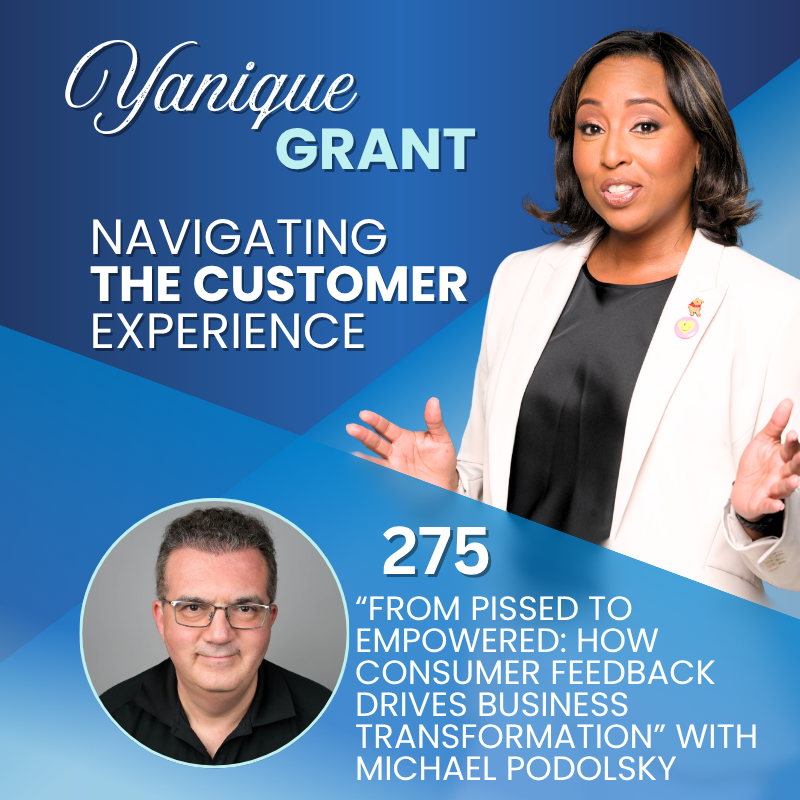
Michael Podolsky is the co-founder and CEO of PissedConsumer.com, a leading consumer advocacy and complaint resolution platform, and Wisebrand.com, an AI strategy and product engineering agency. What started as a personal frustration after a dismal vacation experience turned into a 20-year mission to give consumers a credible voice and help businesses learn from real feedback.
Over two decades, Michael has grown PissedConsumer.com into a platform serving over 30 million users, built on a $200 initial investment and zero venture capital. His philosophy is straightforward: negative feedback is not a liability. It is a learning asset. Companies that treat complaints as gifts and empower their customer service teams to resolve them will outperform those that deflect, delay, and dismiss.
Michael is also a forward-thinking AI integrator, having deployed agentic AI systems across multiple organizations to combine institutional knowledge with machine-driven productivity. He believes this generation of business leaders is the last to manage purely human teams.
Questions Yanique Asked
- In your own words, could you share a little about your journey and how you got from where you were to where you are today?
- What has your experience been since starting PissedConsumer.com? Are organizations actually using the feedback on your platform to improve customer experiences?
- You mentioned that 87% of consumers will contact a company before leaving a negative review online. What does that statistic tell us about the relationship between complaints and loyalty?
- How should organizations categorize the severity of a complaint, and what is your recommendation on timelines for resolution?
- You mentioned that customer service is often treated as a deflection mechanism. What does a successful organization look like when it comes to empowering customer service?
- What is the one online resource, tool, website, or application that you absolutely cannot live without in your business?
- Can you share one or two books that have had a profound positive impact on you, professionally or personally?
- What is the one thing going on in your life right now that you are really excited about?
- Where can listeners find and connect with you online?
Episode Highlights
From a Bad Vacation to 30 Million Users: The Origin of PissedConsumer.com
Yanique: Tell us about your journey from where you were to where you are today.
Michael Podolsky gets used to the stares. Telling people he runs a website called PissedConsumer.com has always required a follow-up explanation. The follow-up is worth it.
The platform was born from a genuinely terrible travel experience. Before the internet age, Michael found himself stuck at a substandard hotel for an entire week with no way out. He was locked into a package deal. He complained to his travel agent, the wholesale tour operator, and his credit card company, and filed a small claims case. Every avenue denied him. The system was not built for the consumer.
So he built one that was. Starting with just $200 and no investors, he created a platform where consumers could share their experiences with businesses and where those businesses could hear, without a filter, what their customers actually thought. Today that platform serves over 30 million users. Over 200,000 businesses are represented on it, and most of them did not sign up willingly.
| “I got pissed once. Today, 200,000 businesses are pissed at me for starting this. But my goal has never been to tarnish anyone’s reputation. My goal is for businesses to learn from their own experiences and from the experiences of their competitors.” — Michael Podolsky |
What Makes PissedConsumer.com Different
Yanique: Do you believe organizations are actually using the feedback on your platform to improve customer experiences?
There are many review platforms. Michael acknowledges that openly. What he argues sets PissedConsumer.com apart is both its focus and its newest feature: collective complaints.
Launched within the past three months at the time of this recording, collective complaints allow consumers to group their feedback around a single company concern and gather signatures that collectively demand attention. The results have been notable. Companies that routinely ignore individual complaints have begun responding to collective ones. The volume and unified message carry a weight that single reviews cannot.
The platform’s core argument to businesses: you cannot be everywhere responding to every review, but you can build the internal systems that stop those reviews from needing to exist in the first place.
| “It is always a consumer’s choice where they leave their feedback. And 87% of those consumers contacted the company first before posting anything online.” — Michael Podolsky |
Complaints as Small Gifts: The 87% and 72% Statistics
Yanique: What does it mean that 87% of consumers reach out before going online?
Michael’s data reshapes how to think about negative reviews. The 87% statistic tells a story not of malice but of unmet desire. Most consumers who leave a negative review online already tried to resolve the issue directly. The business had a window. The business closed it.
A second statistic that emerged in the conversation: 72% of consumers who leave a negative review do so to protect future customers from the same experience. They want to warn others. They want the company to change. They are not trying to destroy anyone’s reputation. They are trying to be useful.
Michael’s framing: negative feedback is a small gift. The consumer is doing the work of revealing a gap that would otherwise remain invisible. Businesses that receive these gifts with gratitude and action build stronger customer relationships than those that receive them with defensiveness or silence.
| “We treat these complaints as small gifts that consumers are giving to companies in order to improve their service. 72% of people who leave a negative review want their followers not to experience the same fate.” — Michael Podolsky |
How to Categorize Complaints and Set Resolution Timelines
Yanique: What guidance do you give organizations on categorizing complaints by severity and establishing timelines for resolution?
Michael’s answer was grounded in organizational structure. The challenge is not just the speed of resolution. It is who is doing the resolving and whether they are set up to succeed.
In smaller and mid-size organizations where conversations happen at the C-suite level, there is often genuine understanding of what brand reputation means and what a complaint costs. In larger organizations, complaint handling typically falls to the customer service department, and that is where the problem lives.
The issue: the department most often blamed for the problem is also responsible for resolving it. Customer service did not cause the logistics failure, the production defect, or the operations gap. But customer service is asked to absorb the anger and negotiate a solution. Without real authority to escalate and fix issues, they become a holding area, not a resolution function.
| “Do you know that customer service is treated by management as a deflection mechanism? You, as a customer, are looked at as an object of deflection. That has to stop.” — Michael Podolsky |
Empowering Customer Service: The Real Fix
Yanique: What does a successful organization look like when it comes to handling complaints?
Michael was direct. Empowerment is the answer. When customer service agents have clear escalation paths, the ability to make decisions, and the support of other departments, the feedback loop works. Issues get fixed. Future customers do not experience the same problems. Negative reviews become less frequent because the conditions that generate them are addressed at the source.
The logic is simple: 87% of consumers talk to customer service before going online. If customer service can resolve the issue, those conversations never become reviews. The work of protection is not reputation management after the fact. It is internal empowerment before the review is written.
AI Tools, Agentic Systems, and the Zoo of Models
Yanique: What is the one tool or resource you absolutely cannot live without in your business?
Michael did not hesitate. Artificial intelligence, in all its forms. His organizations have deployed what he describes as a “zoo” of AI models and agents: systems running on open-source frameworks with 12 agents in one organization and 8 in another, using models from both OpenAI and Anthropic depending on the task.
These agents handle recruitment, operations, marketing, deep data research, and consumer voice analysis. PissedConsumer.com has an extensive volume of consumer feedback data, and AI allows that data to surface insights that would be impossible to extract manually.
His recommendation to other business leaders: do not wait for perfect clarity on AI. Learn it, apply it, and build it into your operations alongside your team, not instead of them.
The Last Generation to Manage Only Human Teams
Yanique: What is the one thing you are most excited about right now?
Michael’s answer was equal parts strategic and philosophical. His organizations have an average employee tenure of seven years, which is exceptional in the technology sector. That tenure represents institutional knowledge that AI cannot replicate on its own. The question he is solving is how to combine those two assets.
His path forward: teach every employee deep and agentic AI. Give them the time and resources to apply it within their own departments. The result he shared with his teams was stark: in nine months, the company would either need 70% fewer people or would need to be ten times more productive. Everyone chose the latter.
| “We are the last generation of people that managed only human teams. We need to retool our organizations to be AI and human mixed. That is the most exciting thing I am working on.” — Michael Podolsky |
Key Takeaways
- Negative feedback is not a threat. It is a signal. The businesses that receive it well and act on it build the strongest customer relationships.
- 87% of consumers reach out to a company before leaving a review online. The review is not the first move. It is the last resort after the first move failed.
- 72% of consumers who leave negative reviews do so to protect future customers, not to destroy a brand. They want things to improve.
- Collective complaints can move companies that ignore individual ones. Volume and unity create a different kind of accountability.
- Customer service is frequently used as a deflection mechanism. When that is the design, no amount of training will make it a resolution function.
- Empower customer service with real authority and escalation pathways. If they can resolve 87% of issues before a review is written, the review will never need to exist.
- AI is not optional. It is infrastructure. The question is not whether to adopt it but how to deploy it alongside your existing institutional knowledge.
- This generation of leaders is the last to manage purely human teams. The leaders who build AI and human integration now will be the ones still leading in five years.
- Institutional knowledge is a competitive advantage that AI cannot copy. Protect it by combining long-tenured employees with agentic AI systems.
- Getting past no starts with listening. Michael’s most recommended book is a guide to negotiation and human persuasion that applies directly to how businesses should approach unhappy customers.
Timestamped Topics
| Timestamp | Topic |
| 00:00 | Introduction and Guest Bio |
| 01:38 | Michael’s Origin Story: A Bad Vacation and a $200 Investment |
| 05:29 | What Makes PissedConsumer.com Different from Other Review Platforms |
| 06:23 | Collective Complaints: A New Way to Get Businesses to Respond |
| 08:12 | The 87% Statistic: Why Consumers Reach Out Before Leaving a Review |
| 10:19 | Complaints as Small Gifts: What Feedback Really Means |
| 11:47 | How Organizations Should Categorize and Prioritize Complaint Resolution |
| 15:29 | Customer Service as a Deflection Mechanism and Why That Must Change |
| 16:28 | Empowering Customer Service to Actually Fix the Problem |
| 17:28 | AI Tools Michael Uses Across His Organizations |
| 19:56 | Book Recommendation: Getting Past No |
| 22:41 | Building a 10x More Productive Organization with Agentic AI |
| 23:16 | The Last Generation to Manage Only Human Teams |
| 24:11 | How to Connect with Michael Podolsky Online |
Featured Resources
Books Mentioned
Platforms and Tools
- PissedConsumer.com — Consumer advocacy and complaint resolution platform: pissedconsumer.com
- Wisebrand.com — AI strategy and product engineering agency: wisebrand.com
- Agentic AI Tools — Michael’s organizations run agents built on OpenAI and Anthropic (Claude) models for recruitment, operations, marketing, and deep research
Connect with Michael
- LinkedIn: Search Michael Podolsky, PissedConsumer — he is the only one associated with that company and welcomes professional connection
- PissedConsumer.com
- Wisebrand.com
Michael responds to LinkedIn connections personally. He asks only that you do not spam him.
Michael’s Guiding Quote
| “We are the last generation of people that managed only human teams.” — Michael Podolsky |
Michael did not have a personal quote or saying ready when asked. But the statement he offered in describing the future of work is the one that anchors everything he is building: a belief that this moment in leadership history is unlike any before it, and that the organizations that recognize that and act on it early will define the next era of business.
About Navigating the Customer Experience
A globally recognized podcast hosted by Yanique Grant, featuring leaders and innovators sharing insights on leadership, business growth, customer experience, and exceptional service delivery.
Follow Us
- X (Twitter): @NavigatingCX
- Facebook: Navigating the Customer Experience Community
- LinkedIn: Yanique Grant
- Website: yaniquegrant.com