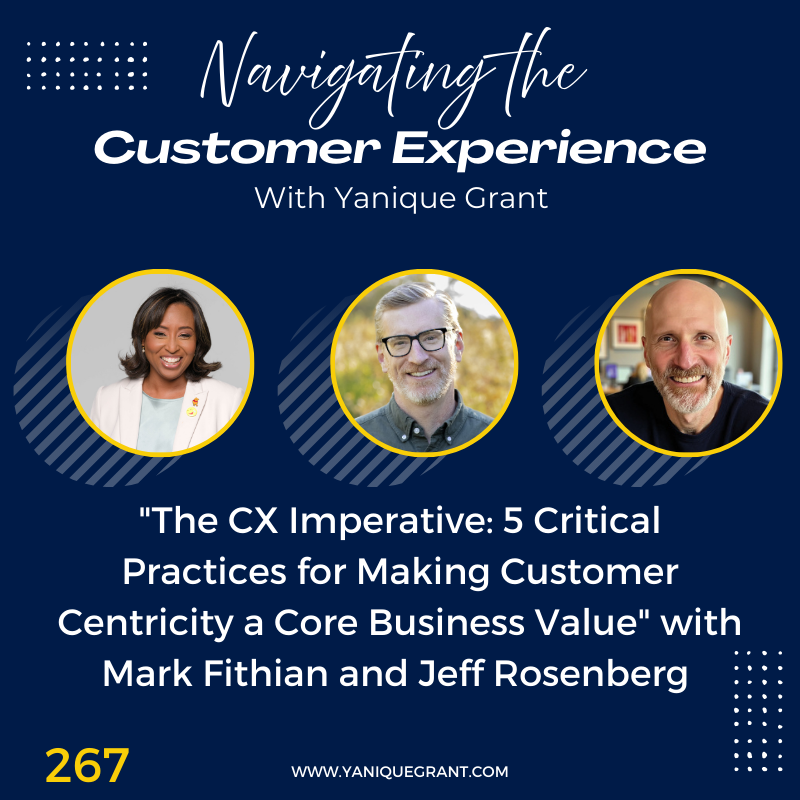
Our guests are Mark Fithian and Jeff Rosenberg, they will be discussing a little about their awesome book that they have published, and I’m just going to give you a quick overview. So, Mark Fithian and Jeff Rosenberg are the cofounders of WideOpen, a Strategic CX consulting company. Mark’s customer service strategy expertise and methodologies were developed through over 30 years of work across multiple industries, collaborating with leading brands such as Providence, SAP, PayPal, Optum, IBM, BMW, the American Cancer Society, and Microsoft. Before cofounding WideOpen, Mark held key roles in both client-side and agency-side positions, as well as in strategic consultancies.
Jeff has spent more than 30 years working across strategy, operations and customer experience disciplines, consulting for leading companies such as SAP, Verizon, Hershey, Optum, BMW, ADT and Motorola. Prior to cofounding WideOpen, Jeff served in leadership and practitioner roles in consulting agency and corporate organizations.
Questions
- Can you share, in your own words, a bit about your journey and how you got to where you are today?
- Your book, The CX Imperatives: Five Strategic Practices for Renewal of the Customer-Centered Enterprise, outlines key principles for customer-centered growth. Could you share three or four of the core tenets of the book, and explain who it’s designed to help?
- Your book highlights five strategic practices at the core of customer-centered enterprises. Could you briefly summarize those five practices, and share examples—without naming specific organizations—of companies you’ve worked with or studied that have adopted them? What tangible and intangible results have you observed, such as financial performance, customer retention, loyalty, or advocacy?
- You mentioned culture and what’s happening inside an organization. In your experience, when customer experience is consistently poor, is it often a reflection of internal issues within the organization? Would you agree?
- I’d love for each of you to share the best customer experience you’ve ever had. Thinking about your everyday interactions, what made that experience stand out, and what one or two elements made it exceptional for you?
- Could you both share with me what’s the one online resource, tool, website or application that you absolutely can’t live without in your business?
- Can you also share with our audience, what’s one book that you have read, it could be a book that you read recently, or even one that you read a very long time ago, but it had a positive impact on you. Do you have one of those?
- Could you share with our audience what’s the one thing that’s going on in your life right now that you’re really excited about, either something you’re working on to develop yourself or your people.
- Where can listeners find you online?
- Now, before we wrap our episodes up, we always like to ask our guests, do you have a quote or a saying that during times of adversity or challenge, you’ll tend to revert to this quote if for any reason you get derailed or you get off track, the quote kind of helps to get you back on track. Do you have one of those?
Highlights
Mark and Jeff’s Journey
Me: So, we can just take it one at a time, but I know we read your bio, but I always like to ask our guests if you could share with our audience a little bit in your own words, a little bit about your journey, how you got from where you were, to where you are today.
Mark shared that he really grew up in the marketing discipline domain, starting in the digital world, and sort of evolving through to more strategic consulting in the marketing realm, and then starting this business about 15 years ago. And the red thread throughout all of that work over 30 years has been this orientation to the customer and helping the organizations he’s worked with and for become more connected to those customers.
Jeff shared that he and Mark has been through similar paths in that they both worked for companies, and they’ve worked for agencies, and they’ve worked for consulting companies, and like Mark, the red thread through his work as well, is this interest in serving customers better. He remembered sitting in some meetings in his early days of his career, wondering, “If a customer was in the room in this meeting, would the company be embarrassed or proud?” And generally, it was, it was embarrassed. So, he decided that his interest in the customer, he could do something about that and choose a path that focus on the customer. And they have certainly ended up in a place now where they’ve written this book on customer experience and really trying to raise awareness of how customer centricity can help drive growth and innovation in companies.
Core CX Principles and Who the Book is Designed to Help
Me: So, you have this awesome book, and I’m kind of just going to hold it up here so our listeners can see it. Plus, I notice you also have it in the background of your videos today. It’s called The CX imperatives: Five Strategic Practices for Renewal of the Customer-Centered Enterprise. Could you share a little bit about maybe three or four overarching tenets that the book focuses on and who is the book geared towards? Who can this book really help?
Jeff shared that they wrote the book for people who already have a predisposition to care about customer experience and potentially be in the customer experience space already. They’re not trying to necessarily write the book to pull in new people into CX. It would be great if we do pull new people into CX, but it’s really A Practitioner’s Guide to how you become more customer centric across the enterprise, which is a challenging but doable proposition. They’re trying to raise awareness of CX as a driver of growth and innovation, not just as a presentation layer, execution of a wow experience here, a wow experience there. In fact, it’s not even about a wow experience, it’s about consistent experiences across a customer journey that are relevant for the brand that the company is putting into the marketplace. So, they have these five principles and pillars for achieving that customer centric approach to the customer experience organization-wide.
And so, they wrote this book to arm people who do customer experience to re-engineer their internal organization, to become innately customer centric.
Me: Okay, would you say the book is geared towards a particular industry, like maybe telecommunications, banking and finance, retail, or is it applicable the strategies that you have in there to any organization, whether that’s small, medium or large.
Jeff shared that it’s really industry agnostic, because they have found, through working across a wide range of industries that no matter if you’re B to B or B to C, or your consumer good or you’re an industrial machine company, the principles of customer experience still apply. A lot of the same frameworks can be shared across numerous industries, because in the end, we’re talking about driving human behaviour and persuading people or encouraging people to do certain actions that benefit both them and the company. So really, the frameworks are applicable across industries.
Five Strategic CX Practices and Their Business Impact
Me: Now, in the book, you talk about five strategic practices that’s written on the cover of the book, I would like you to give us, in a very summative way, what those five strategic practices are, and you don’t have to call the organization’s name, but maybe, if there are any companies that you’ve worked with, or maybe organizations that you have observed through research, that you have noticed that they’ve actually adopted these principles, and what has been the result, as a result of putting these principles into practice, what have you seen? Is it that it only increases their bottom line? Do they have high customer retention? Is it that their customers are raving fans, and walking about spreading great news about their business? What have been some of the non-tangible as well as tangible results that they’ve seen as a result of putting these practices in place?
Mark shared that the five practices, and he’ll sort of go left, left to right, not top to bottom, they’re all critically important. But it starts with insights, really gaining insights that help organizations understand humans, not just as numbers and spreadsheets, but like as emotional beings. It’s like you and me and you need to understand that as an organization, not relegated to one specific department, but there are people already doing some of that work within many corporations, as you well know.
The next piece is using that insight and marrying that with the corporate objectives and strategies to define a CX strategy itself that says what’s the most important work for us as an organization to be doing across the journey? So, insights, strategy.
Then the third pillar is blueprinting, which is translating that strategy in a way that the operations can actually implement it.
And then, from that, the fourth pillar is an operating model, meaning that, as you know, the work of CX is typically something that’s done across many different parts of the organization, which is one of the big challenges you might say, it’s not just the marketing department or the customer success department or the operator or the finance people, it’s all of these people. And so, they need an operating model that allows them to do that work together that’s a little bit different than the other way that they may function. And so, that’s things like, roles and responsibilities and processes and shared expectations that let them do this kind of work more effectively and with greater success for you and me as customers.
And then finally, is the piece of culture, which, even though it’s last, it’s still super important, which is making sure that the organization believes in this work, that they understand this work, that they believe in it, and that they have the tools to actually implement it. Because so much of CX work, particularly in certain industries like healthcare, retail or service, or hospitality, like experience lives or dies, whether or not the person who’s delivering that believes, understands it, believes in it.
So, those are the five principles, and he will give you, without revealing any proprietary information, an example where they did what he considered to be some of the most exciting work in CX for a healthcare client of theirs that really leaned in on the culture piece. And as he said, culture has a huge driver of success in CX for these kinds of industries.
And they did a project with the organization to help them better serve patients who were minority communities, who would show up for healthcare, but had trouble accessing it because of language issues, and what they did was really involve the frontline caregivers, clinicians in helping to design a better approach to customer experience using some of these other principles that he talked about, so giving them the insights, the right strategy, the framework for doing it together, and empowering them to come up with the right solution.
And the reason he brings that forward is because it not only produces, he think, 60 or 70 specific initiative, multi-million-dollar initiatives that save money and drew growth, but it was sustainable because the people who came up with the solutions actually implemented the solutions and therefore had a vested interest in their success. So, he just gave that as kind of a space of CX that he thinks can be really, really powerful, is bringing the culture of the organization into the work.
Jeff also shared that he just thinks when we talk about impact, a lot of the work they do is impacting the organization itself to then go out and do marketplace initiatives or innovations that drive growth and reduce costs, as Mark mentioned. So, it’s not to them necessarily about 2% uplift in a marketing campaign, as much as it is arming the organization with the tools and mindsets to then execute CX in a way that they’re addressing customer opportunities profitably. And really, their work is around driving that kind of growth and cost containment. And that’s the impact that that this work enables.
Organizational Culture as the Root of Customer Experience
Me: Now, you spoke about culture, and culture has to do with what’s happening in the organization, on the inside. And I find that in a lot of organizations, when there’s a consistently poor customer experience, it’s usually a symptom of something that’s happening internally. Would you agree?
Mark agreed and shared that he thinks most people who come in contact with customers truly firsthand, and many in leadership and in middle management don’t ever talk to customers, but those who are on the front line have an intimate understanding of customer pain point and a desire to fix it, because they’re the ones who sort of get the blow back. And also, when things work great, they want to celebrate that, but they’re a great resource in helping their organizations be better.
Me: Agreed, so I’m kind of glad you brought up leadership just now, because I’d like to know what your approach has been when you work with organizations, if leadership they’re not fully on board with all of the different initiatives that you’d have mentioned. Do you find that it still works if they’re not behind these initiatives 100%?
Mark shared that they always say to their clients, you need to work with the organization you have, not the organization you wish you had. And you will always have in any organization some segment of people who don’t understand, don’t believe, don’t agree, reject what you’re trying to do. You will also have some segment of your organization, your leadership, that are huge advocates of what you’re doing, and leadership belief in that, and then everything in between.
So, if you’re a CX leader, your job is to work with all of those different people. And the people who are, you might say, rejectors of CX, are going to need a different approach than the people who are already believers. Certainly, the people with believers you want to activate and channel their enthusiasm to produce new experience. But the people who are rejecters may have very, very legitimate reasons for rejection that you need to understand as the CX leader and then work with them. It could be conflict, it could be prior failures in CX, it could be questions of the business case, so you need to meet them where they are, and ultimately, help them understand that this is a better way.
Your Best Customer Experience That You Have Ever Had
Me: Now, I’d like each of you to share with me the best customer experience that you’ve ever had as a customer. Think about your own interactions in your daily lives. What would you say was the best customer experience if you had and why would you consider it to be your best, what were maybe one or two elements that you believe make it stand out than any other experience you’ve had?
Jeff shared that the first one that comes to mind is Delta Airlines, and he’s a frequent flyer with Delta Airlines, have been for many years, and he’s noticed some pretty significant improvements over the years. And it’s not about some of the core aspects of an airline experience you would recognize. Most people have issues with airlines that we’re all aware of what those are. They have done some very intentional work around the customer experience; he’ll give you a couple of examples. It used to be sort of a focus on what happens at the gate and then what happens in the air. And he noticed many years ago that they started introducing some experience improvements in between those two major events in typical flight.
So, one is even just making the jet way when you’re standing in the jet way, making it a little bit more pleasant to be in there, just by keeping it clean, putting up signage and sometimes art just to kind of keep your mind occupied. And then when you’re sitting, waiting for take-off, they play pleasant music, which is obviously designed to help allay and reduce anxiousness of are we going to take off on time, or people hitting people with bags, etc, as they’re walking by, walking down the aisle. So, they’re trying to address that anxiety, as well as when they started introducing mobile notifications when your bag was loaded on the plane. Again, it doesn’t change where the bag is, but it changes how you feel about your flight experience.
So, he thinks they’ve done a lot of other things across the entire end to end journey. But he thinks the point is that they’ve taken a very intentional approach to creating these experiences and really thought through the journey, not sort of an operational pillar point of view, but really, okay, what let’s look at this experience through the lens of a traveler and everything they’re doing and seeing, and how can we introduce experience improvements to make that a better overall experience.
Mark shared that his example is a few years old, but it’s still one of his favorite experiences. Is with a healthcare organization of all things, called Kaiser, he’s not sure if you’re familiar with them, but they are a model where they combine both the care delivery, so they have the hospitals and the clinicians and things as well as the coverage, as opposed to those things being separate, like insurance company, and then care delivery, these are integrated. And then when you join Kaiser, you become what’s called a member of Kaiser, and then you get all your care through Kaiser.
So, he joined Kaiser, he and his family joined Kaiser about maybe 10 years, 10, 15 years ago, he thinks at this point. And one of the things that they did, which was just amazing, not only because it’s healthcare, and healthcare gets zero credit for having good experience by and large. In fact, it’s the opposite. But he thought it was great, just for business writ large. But when they joined Kaiser, one of the first thing they did was they invited them as new members to one of their hospitals. And when you walked into that hospital, you were greeted by the head of the region, the head of the hospital, several of the surgeons, the nurse practitioners, and then you had basically a morning to get set up to become a member, quote, unquote, of Kaiser.
So, you get all your you could go get blood work done, you get labs done, you could get health care power of attorney, you could get app set up. They had food and lunch, and the kids could play around and meet people, it was crazy. It was just the most un healthcare like experience. And you walked out of that feeling like very empowered as a customer like, “Okay, I’m set to really take control of my health, and they’re going to be an amazing partner in this.” He doesn’t know whether they still do it, but it sticks with him as one of his favorite customer experiences.
Me: You still do business with them, right? You just haven’t had a chance to go into the hospital.
Mark stated that he hasn’t, he’s just a customer of theirs, but he works a lot in that sector.
Me: Got it, awesome. And then I guess, because healthcare already has such a negative experience attached to it, for most people in this country, it’s a pleasant surprise when you do have an experience where you know people are operating outside of how you’re expecting them to act.
App, Website or Tool that Mark and Jeff Absolutely Can’t Live Without in Their Business
When asked about an online resource that they can’t live without in their business, Jeff shared that aside from Office, for him, it’s Note taking app, whether that’s Evernote or OneNote, because it syncs across devices, and just to have access to things that he’s jotted down, or project notes or client notes or ideas or thoughts or it really helps him keep on top of everything. And so, it’s not super, whiz bang or futuristic, but it is just a solid piece of his world that exists across all devices, and he just couldn’t get by without it.
Mark shared that he’d probably say LinkedIn. He just thinks as a relationship-based world, was going to say business, but really, it’s a relationship-based world, there’s really nothing like it. For us to be able to connect with peers, understand kind of their background and dispositions through things like they may be posting on the platform, it’s a hugely important resource for him, for us.
Books that Have Had a Great Impact on Mark and Jeff
When asked about a book that has had a positive impact, Mark shared that he has a book that he loves, he was just rereading it. It’s called The Art of Possibility. It’s by a husband and wife, he was head of the Boston Symphony, and she’s a therapist. The Zanders are their name, and it really is about sort of the mindset around being successful and having kind of an abundance approach to life and using that to drive a lot of your behaviour. So, it talks about the 12 specific practices that they have used in their world. And it’s interesting because it uses it not from a business standpoint, but from he’s a musician. So, explaining these principles through a musician’s lens is helpful. He’s (Mark) a musician, he kind of can relate to that, translating that to business environments.
Jeff shared that he got a couple. If he looks back across his life, he thinks the one that stands out the most is called The Discipline of Market Leaders by a consultant named Michael Treacy. He became aware of it in the mid 90s, and it was his first introduction into this idea of making strategic choices and then lining up all your resources behind it to power that choice. So, he had this idea of, there’s three ways, they all come into play for every company, but there’s three tips of the pyramid for any company. Can be around product leadership, customer intimacy or operational excellence. And whether you think those are the only three or not, is really immaterial. But this idea that companies can make an intentional choice of what they’re going to lead on and then just organize the entire corporation behind that. That was his first introduction to that concept, and he’s been working with that ever since, about sort of an understanding of the power of choice and focus, and how companies don’t have infinite resources, and we need to choose to spend our money wisely and against a common North Star.
What Mark and Jeff is Really Excited About Now!
When asked about something they’re really excited, Jeff shared that for him, and he’ll say them, is the book that they’ve written, and the idea of capturing and then turning inside out to the broader community, the frameworks and methods that they have been working with and honing over the past 15 years in this business, and the previous 15 years in CX.
Packaging that up, making it available for anyone to leverage, it’s incredibly exciting, and they hope it inspires people to take a lot of action from the book, and think about CX in a different way. This has been a terribly exciting process of writing the book and then, releasing it, and talking about it and getting into people’s hands that they had never met previously. It’s just been a very exciting, very exciting time, and it’ll continue on into the near future here.
Mark shared that he would just echo that. He thinks it’s exciting to be in the world of CX right now. It feels not that he was alive back then, but in the 50s, there wasn’t something called marketing, per se. It was called advertising or merchant; it isn’t what is known today. And he feels like we’re in that phase where CX is really still, it’s coming together in a way of in of its own, in a more formal way that it can be kind of woven into the business more explicitly.
He was at a class at the University of Washington just talking about CX, which he loves doing. That’s one of his favourite things to do. And he can imagine that not too far in the future, there is going to be kind of standard curriculum in colleges that says this is what CX is and how it is used, and why it’s so critical for organizations to have it, alongside finance, human resources, strategy, marketing, we’re right in that phase right now, and so it’s really exciting having been in CX for so long to be part of that.
Connect with Mark and Jeff Online
LinkedIn – Mark Fithian
Website – www.thisiswideopen.com
Quote or Saying that During Times of Adversity Mark and Jeff Uses
Mark stated that he doesn’t know if it’s a quote, but his mantra is, “A boat is safe at shore, but that’s not what a boat is built for.” Meaning, boats are meant to go out into the ocean, and explore, and it’s unknown, and sometimes it doesn’t behave the way that you want it to, but you’re built for that. It’s okay. You have to be able to navigate that ambiguity and being a small business entrepreneurs. He and Jeff, they have a lot of ambiguity that they navigate, and that’s part of it, but they have a great boat that they have to navigate that. So, he thinks that would be his, he has to remind himself that mindset.
Jeff shared that he doesn’t go to quotes, he goes to just breathing and staying in the moment. He’s a long-distance runner, and he had found that if he started thinking about the end too early, it’s very discouraging. So, he’s always telling himself, “Stay in this mile. You’re in this mile.” And that’s where you are, and don’t worry about the future. You got to stay present and just don’t get anxious about things you can’t control or things that haven’t arrived yet. And you just got to be happy in the moment. So, he kind of anchor himself in that way and being present.
Me: Thank you so much for sharing gentlemen. Well, I really enjoyed our interview talking about your book, CX Imperative. And just one more question, do you do workshops around this book, like open workshops if our listeners wanted to maybe tap into a webinar that you’re doing, or a one day workshop, they could tap in.
Jeff shared that they sure do. And people can reach out to them, and they do lunch and learns or workshops either covering the five practices outlined in the book or digging deep into one of them. And so, they’re happy to do that anytime if people want to reach out to them.
Me: Perfect, I’m so glad you shared that. So, thank you again, Mark and Jeff, for coming on our podcast, Navigating the Customer Experience, really was a very informative conversation talking about the different strategic practices, the examples that both you, Mark and Jeff gave as it relates to what those strategies are, how organizations can use them, and the fact that it’s a consistent engagement that will result in creating the experiences that your organizations would want to experience. So, I would definitely endorse the book. I haven’t finish reading it yet, but it’s been quite informative so far and I’m glad I was able to have a direct conversation with the authors to even get more insight onto what the strategies were, what were their thought processes behind it, and what were some of the success stories that they’ve experienced working with organizations that have put these things into practice. So, thank you again so, so much for joining us here on our podcast today.
Please connect with us on X @navigatingcx and also join our Private Facebook Community – Navigating the Customer Experience.
Links
- The CX Imperative: Five Strategic Practices for Renewal of the Customer-Centered Enterprise by Mark Fithian and Jeff Rosenberg
- The Art of Possibility: Transforming Professional and Personal Life by Rosamund Stone Zander
- The Discipline of Market Leaders: Choose Your Customers, Narrow Your Focus, Dominate Your Market by Michael Treacy
The ABC’s of a Fantastic Customer Experience
Grab the Freebie on Our Website – TOP 10 Online Business Resources for Small Business Owners
Do you want to pivot your online customer experience and build loyalty – get a copy of “The ABC’s of a Fantastic Customer Experience.”
The ABC’s of a Fantastic Customer Experience provides 26 easy to follow steps and techniques that helps your business to achieve success and build brand loyalty.
This Guide to Limitless, Happy and Loyal Customers will help you to strengthen your service delivery, enhance your knowledge and appreciation of the customer experience and provide tips and practical strategies that you can start implementing immediately!
This book will develop your customer service skills and sharpen your attention to detail when serving others.
Master your customer experience and develop those knock your socks off techniques that will lead to lifetime customers. Your customers will only want to work with your business, and it will be your brand differentiator. It will lead to recruiters to seek you out by providing practical examples on how to deliver a winning customer service experience!